Showing posts with label Islam. Show all posts

February 16, 2007

A Shi'i-Sunni problem?

Is the current violence in Iraq a Shi'i-Sunni problem? A divisiveness that is hundreds of years old on which a lid was put by Saddam's iron-hand?

A very complicated question.

For a fine analysis and response, turn to Haroon Moghul, of Eteraz fame.


.

Shia's and Sunnis on NPR


The Partisans of Ali
A History of Shia Faith and Politics.
I haven't listened to all the parts. But I can vouch that NPR (National Public Radio) is usually interesting
Click here for a background and the 5-part series:
More on this, to come.

February 15, 2007

Mohsin Hamid


Most of you guys, readers of Addafication, will have a sense of the term "Exile Complex."

It is a feeling of nostalgia for a home far away. The nostalgia is often wrapped around imaginations of a city - its smells, sights, sounds, and friends it contains.

The city remains geographically far but conversationally very near. It is evoked in the movies we like to watch. Perhaps more so in the music we listen to, and the older we get, the more we realize the encroaching influences of our old selves, old homes, and old cities, in our lives.

This past summer, I greatly enjoyed Baul music. But when I was thirteen, if you had snuk in a Baul or Lalon tape in my replete collection of the Seattle Grunge Scene, chances are, I'd be a bit annoyed with you. Things have changed. As have tastes.

All this then fall under the "Exile complex"

Also, in some ways, it is because of this very Exile complex, that we South Asians, Bengali, Indian, Pakistani or what have you, enjoy reading post-colonial literature so much.

Post-colonial literature?

I am sure Wiki has a definition, but just think of the kinds of literature Salman Rushdie, Jhumpa Lahiri, Arundhati Roy, Vikram Seth write.

They are about the former colonies and one of the objectives in these literatures is to show the effects of the long colonial hangover that exists in former colonies.
And the way in which people from the colonies, mostly Brown folks like you and me, negotiate modernity, westernization, et all, while trying to retain aspects of our cultural and religious pasts.


That said, post colonial lit can get a little tiresome. Some greatest hits aside, a lot of the new stuff that comes out keep re-inventing the wheel. Soon, all plots and characters start to look the same.

But a breath of fresh air, in the midst of such re-inventions, is Mohsin Hamid.

In fact, Mr. Hamid may even be my hero.

Brought up in Lahore, educated at Princeton and Harvard, Hamid worked for McKinsey and eventually wrote his first novel, "Moth Smoke," which became rather huge. The story: Darashikoh, a banker in Lahore manages to lose his job and fall in love with his best friend's wife at the same time. A life of drugs and crime await him and soon absorb him into its fold.

Lots of depth here though.

The story is an allegory of both the trial of Mughal prince Darashikoh by his brother (17th century), the infamous Mughal ruler Aurangzeb. Also allegorized is the state of Pakistan of the late 1990s when the country went nuclear.


So am eagerly awaiting Hamid's new novel, titled, "The Reluctant Fundamentalist" (forthcoming, Arpil 2007).

From Kirkus Reviews:

Changez (our hero) describes in eloquent detail his arrival in America as a
scholarship student at Princeton, his academic success and lucrative employment
at Underwood Samson, a “valuation firm” that analyzes its clients’businesses and
counsels improvement via trimming expenses and abandoning inefficient
practices—i.e., going back to “fundamentals.”
Changez’s success story is crowned
by his semi-romantic friendship with beautiful, rich classmate Erica, to whom he
draws close during a summer vacation in Greece shared by several fellow
students.

But the idyll is marred by Erica’s distracted love for a former boyfriend
who died young and by the events of 9/11, which simultaneously make all
“foreigners” objects of suspicion... and exits the country that had promised so
much, becoming himself the bearded, vaguely menacing “stranger” who accompanies
his increasingly worried listener to the latter’s hotel...A superb cautionary
tale, and a grim reminder of the continuing cost of ethnic profiling,
miscommunication and confrontation.

Exciting.
If you find Mr. Hamid's work and thoughts as interesting as I do, check out an interview with Tehelka. An excerpt:

Tehelka: How has Pakistan negotiated modernity?

Hamid: In remarkably
complex ways. You have everything in Pakistan — mini zones of talibanisation,
fashion shows with girls wearing next to nothing in Lahore, parties in Karachi
where people are doing cocaine and Ecstasy, villages where people don’t have
education or electricity. It’s a huge collage.

The thing people often forget about Pakistan is that it’s enormous. It’s the sixth biggest country in the world. China, India, US, Indonesia, Brazil, then Pakistan. It’s only when you
compare it with something even more galactically vast like India that it seems
anything but huge. So there’s a huge diversity in the way people are dealing
with modernity — from complete hedonistic embrace to religious reactionism.

February 14, 2007

'71 Part One. A Mindset of Mutual Exclusivity

In Bangladesh, events of 1971 have cast a very long shadow. A shadow that has lodged itself in the subsequent history of the nation. And even harangues the present.

Memories and rhetoric around '71 configures party politics. They shape foreign relations and populate imagination of artists, novelists and activists.

Two years ago, I spent a good deal of time in London. The University at which I did my MA, didn't have many Bengalis. Not being particularly ethnocentric, I didn't necessarily miss being around my Bong buddies. But eventually, I was broken into the community at Bricklane.

Many of my British Sylhetti friends were already suspicious of me because of they considered me Americanized. The idea of America didn't seem very popular among many British Bengalis, try as I might to explain my nationalist loyalties didn't necessarily lie there.

One of my friends asked me quite wittily, "So since you want to call French Fries Freedom Fries, why not call Pizzas Circles of Justice?"

At any rate, these Bengalis in London I was hanging out with were far from the religious types. Most of them were involved with various underground art and music worlds. And religion seemed as big an anathema to them as America.

At one point that evening, one of them asked me how I felt about 1971. It was a strange question. The answer seemed obvious to me.

So I asked him more specifically what he meant. My new friend went to ask if I picked the Bengali side or the Muslim side in that fight. Generally impatient to such crude, sophomoric taking of sides, I told him, "neither."


My friend didn't seem too happy with the answer. I tried explaining to him how at no point, did the freedom movement assume an anti-Islamic color. If anything, journalists like Lawrence Lifschultz who became famous for their valorous reportage of events of '71, went to great lengths to point out the piety of Bengali Muslims before, during and after '71.

Of course champagne socialists and fashionable Marxists were outspoken. But they were hardly representative of the larger fabric of Bengali Muslim society.

Bengali or Muslim? I can't help but sense what really lurked behind it was another question, "Awami League or BNP?"

Sure enough, it came.

"So are you Pro-Indian or Pro-Pakistani. "Neither," I told him. "I am pro-nothing. I like both India and Pakistan. Although I am not sure what you mean by 'Pro-India' and 'Pro-Pakistan.'

(To be continued)

1971 Series


Leading upto 21 Feb, Addafication will feature a series of posts on '71, Pakistan, and the creation of Bangladesh. As well as the Mujib and Military Periods. Stay tuned.

Speaking of Pakistan

This Tuesday, at 11:00 AM, I am lecturing on Jinnah and the Muslim League as a part of a South Asia course. 2nd floor, Mathematics Building, Columbia University, if you want to make it.

I am a tad nervous. Not so much because of stage fright, but more so because it's always hard to talk about Jinnah and the idea of Pakistan. Too many people seem to have axes to grind when it comes to this topic. I have none. I care about being sensitive to all sides.

The idea of Pakistan is intrinsically tied to both Pakistani and Indian nationalisms. For the Indian state, the fact of Pakistan's creation was anathema because it gave the lie to its claims to represent both Hindus and Muslims of Hindustan.

Of course to Pakistani nationalists, the idea of Pakistan is deeply meaningful. Pakistan meant to be the homeland for all of South Asia's Muslims. Critics of Pakistan point out that Jinnah's two-nation theory - that Muslims and Hindus were two separate nations - was an outcome of colonial rule and thinking. They criticize Jinnah for adopting it. Other critics have alleged that Pakistan was merely a bargaining table for Jinnah.

They point to facts of post-47 history to validate these claims. Urdu was popular largely among the Mohajirs from India and Punjabis. The Punjabi-Mohajir nexus was set in place as long as Punjabis dominated the army, the most powerful institution in Pakistan by far.

Meanwhile, Balochis, Sindhis, Bengalis and Pathans all demonstrated autonomous tendencies in varying degrees - the most outspoken of them being perhaps the Bengalis and Balochis. Many of these autonomous movements were borne of an expression of cultural distinctiveness.

I heard recently that in the Balochi uprising (that Mr. Bhutto suppressed with an iron hand) many of Sheikh Mujib's writings and formulations for East Pakistani autonomy were widely read in Balochistan.

Was Jinnah's Pakistan then a mistake?

There are defenses possible of course to Jinnah's designs.

Jinnah wasn't necessarily the Miltonic self-absorbed nation-maker that many of his critics like to see him as. It was important from him to have a flexible idea of Pakistan because its spatial boundaries were far harder to define, as Indian Muslims were diffused all over. It was important for the idea of Pakistan to develop gradually.

And Jinnah wanted a far more complex Pakistan. First up, he wanted the whole of the Punjab and the whole of Bengal. This would have made a substantial difference.

Think about this. Sikhs and Hindu Punjabis continued to dominate the Indian Army at least for a while, the way Punjabi Muslims dominated the Pak Army. If Pakistan included the whole of Punjab, the Pakistan Army would have been mighty. And religiously diverse.

Religious diversity in the most important state institution of Pakistan would have gone a long way in defining its nationalism.

Secondly, if Pakistan had the whole of Bengal (Jinnah wanted Calcutta), the civil-bureaucratic administration of new Pakistan would have been far more colorful and complex. Bengali Hindu Bhadraloks, were prominent in the early years of the Congress in the early days of India.

If Pakistan had absorbed these Calcutta-based civil servants, bureaucrats and intellectuals, their presence would have greatly changed the character of Pakistan. We would have had on our hands, a far more composite, pluralistic and diverse Pakistan in the upper echelons of civil-bureaucratic-military administrations.

However, the realities of 1950s and 60s Pakistan were starkly different. The state failed to incorporate the Bengalis of East Pakistan into its fold, neither economically nor politically or culturally, and events of '71, perhaps not in their gruesome form, now appear inevitable to those that look back and reflect.

To my Bangladeshi and Pakistani readers:
The post is not an exercise is pro-Pakistani nostalgia or anti-Pakistani rhetoric, but in reminding ourselves of the complex trajectories of history that are too often levelled into simple narratives.

A great interview with Shabana Azmi


Ever heard of the Indian New Wave?

The Indian New Wave or "Parallel Cinema" was largely a movement to produce high-quality Indian films, rich in plot and texture, to counter the incessant saccharine feel-good and formulaic Bollywood productions.


A sitar of this movement was the distinguished Shabana Azmi. I remember Ms. Azmi from Masoom, a movie that left quite an impression on me as a child. The songs were great, as were the child characters. And D.K. Malhotra played by Nasiruddun Shah was memorable.


Recently interviewed by BBC's Mike Willaims, Azmi shoots from the hip. Very conscious of her femininity, she speaks of growing up in a famous family, marrying a famous Urdu poet, her multiple identities - resisting any neat categorization. Always displaying a characterstic confidence, she breaks down tough questions re: women's rights, marginal voices, her involvement with politics, and Islam.


Click here for the interview.

February 08, 2007

From Dhaka and Tehran

So I tend to like most things Persian - Kiarostami, miniature paintings, khoresht, the excessive use of nuts and saffron in "polow" - and almost all of whatever I have been exposed to - of Persian architecture, arts and literature. I also love how Farsi sounds.

I was once shooting the shit with a Professor of Islamic History and he pointed to me, how political Islam has had an uneasy relationship with both Iranian and Bengali society. Perhaps.

I suppose the presence of long secular cultures, very productive in the arts and literature, true for both Bengal and Persia, might create problems for certain kinds of Islamisms. Of course, the history of political Islam in any Muslim country is nothing if its not inconsistent and checkered. So it's hard to generalize.

Another interesting analogy between Bangladeshi and Persian societies is the central role Dhaka and Tehran University have played in defining their states' religio-political cultures.


Dhaka University, founded soon after the first Partition of Bengal, to uplift the Muslim masses of East Bengal, went from strength to strength and played a pivotal role in nationalist politics leading up to 1947. After 1947, the university changed character dramatically, as many Hindu Bengalis vacated faculty positions and were replaced by an expanding Bengali Muslim intelligentsia. An intelligentsia that was increasingly secular in the way it imagined a raison d'etre for East Pakistan, and if not that, at least culturally very proudly Bengali. In 1952, the University became a central hub of demonstrations against the Pakistani State. Again, in the '60s, throwing their weight behind an increasingly outspoken Sheikh Mujibur Rahman, the University students and faculty came under the radar of the Pakistani State. Little wonder then that many of the Pak Army's worst atrocities were carried out on the campus during Operation Search Light.


Tehran University was founded roughly sixty years before Dhaka University. The University was formed by integrating various independent faculties and schools. Initially, heavily influenced by French curricula, after WWII, it tried to Americanize its system more. Tehran University also became a battleground on which various religious and political skirmishes were fought by those struggling for state power. Of course the students have been more than pawns in these great games - they have played a central role in them.

In 1979, when the world watched a revolution as momentous as the French or Russian, a lot of impetus to Ayatollah Ruhollah Khomeini's anti-Reza Shah rhetoric came after mass-atrocities on the TU campus. The campus fell under the control of anti-state guerrillas who made weapons and Molotov cocktails . Of course, the agitation had deeper roots. The leftist, liberal Tehran University elements also witnessed the 2,500 year-old celebration of the Persian Empire as Reza Shah threw a party to end all parties. Pro-American, anti-leftist, anti-Islamist, Reza Shah alienated many, and as draughts raged in Baluchistan and Sistan, he had two hundred chefs flown in from Paris, served a ton of caviar and spent between $50 to a $100 million dollars for lots of corporate guests, both Western and Iranian. Students of Tehran University weren't very impressed.

Of course, the students of both Dhaka and Tehran University continue to be politically active. Although politically conscientious voices are fast disappearing on the DU campus, as Shibir cadres are increasingly ensconcing themselves there. Still DU remains a hot-bed of anti-state politics. As does TU, witnessed by the violent protests against against the closing of the reform-minded newspaper, Salam, and more recently against Mr. Ahmadenijad.


Academically, both universities are formidable with a former alumnus/a in each case, bagging a Noble Peace Prize recently: Shirin Ebadi in 2003 and Muhammad Yunus in 2006.

February 07, 2007

"Violence is the Last Refuge of the Incompetent"


Excerpts from an interview with Hamza Yusuf Hanson on PBS:

"Listen, hurricanes are a much greater threat to us right now. Katrina did much more damage than anything the terrorists could ever put together."
"Yeah, there's nuclear weapons are out there and that certainly is a concern. That's the job of these intelligence people to stop that, right? But stop making us all live in fear and telling us about orange and red levels. All that nonsense just simply has to stop. We need to calm down and think at a deeper level. People can't think when their minds are clouded with fear."

"A democracy is predicated on an educated citizenry. You cannot have a democracy with people that are more interested in what Nicole Kidman is doing or whoever the latest fashion model is. If that's your interest, democracy can't survive. You also have corporate interests here."

"How do you racially profile terrorists when 90percent of the world falls into that? Mexicans look like Arabs, for God's sake, and anybody can change their name. I mean Abdullah can change his name to Eduardo. It's not going to be difficult, if they're clever. So how do you profile people?"

"So we have real concerns. You have to go to a deeper level. Henry David Thoreau said for every thousand people hacking away at the branches of evil, there's only one person hacking away at the roots of evil. I really think we need to go to a deeper level and look at what the root of this situation is. There are a lot of people prevaricating out there, who just don't want to deal with the "why" question."


"People have to be exposed to Muslims, just experience Muslims; talk to them. Reach out, read about Islam, try to find out about it. There are 20,000 Muslim physicians in the United States, Americans putting their lives in the hands of Muslims every day. You're going under and the anesthesiologist is a Muslim, right? He's looking out for you. He doesn't want you to die in that operation because you're an infidel. He's doing his job. As is your pediatrician who's trying to heal your child. And the mechanic who's fixing your car?"

Click here for the complete interivew.

February 06, 2007

Family Memories?

These days I am fascinated by the workings of old, handed-down, memories. I was reading somewhere for a project on Sufism in America, how African American Islam and its "explosion" in the '70s had something to do with the fact that some of the founding fathers, Elijah Mohammad and Noble Drew Ali, all had family memories of Islam.

Family memories?

A personal example from my own family: My family is Bengali Muslim. But my maternal grandparents are from parts of what's today Bangladesh (Bikrampur/Vikrampura) where many Hindu kingdoms flourished. And we know that many of maternal ancestors were Hindus, not so long ago either.

I recall childhood memories of my grandmother's overwhelming knowledge of various Hindu rituals local to Vikrampura. She had memories of her mother (Jajabor's great grandmother), sticking leaves between pages of books to call upon the goddess Saraswati and her blessings, although she was Muslim. Of course, we all know about Bengal's syncretic Muslim past in which local Hindu-Buddhist and Muslim traditions intermingled freely.

My mother is also acutely aware of such aspects of our ancestral past. I, myself, will probably continue to hand down the baton of such family memories and conversations.

The idea that a conversation can survive four or five generations may ring true, what may appear less obvious is the idea that the proliferation of Islam among African Americans in the 1970s, had much to do with family memories of Muslim slaves brought over from the African continent by the British centuries earlier.

Both Elijah and Drew Ali's ancestors were slaves. But they worked in plantations on the sea-coast islands of Georgia and South Carolina. In these predominantly sugar and rice plantations, slaves outnumbered slave-masters by much, and a degree of cultural autonomy was possible, enabling the Islam that came from Africa to America to survive and its memories linger across generations.

Don't know how many of you ran into the story of Mayor Ellis recently. I was intrigued to see how this sort of reawakening of very old and inactive traditions still happens. Georgian Mayor , Jack Ellis, who converted to Islam, spoke of "family memories" as he explains his recent conversion to Islam.

February 05, 2007

NYTimes on Ramadan: Islam in a Secular World III


So I can't make up my mind about New York Times. Of course, I can't expect a creature from the jungle that is American media to settle in completely with my Weltanschauung. But I have to say that, for the most part, I enjoyed Ian Buruma's piece on Tariq Ramadan. Although, it did seem at times, Buruma was looking for the fanatic in Ramadan and is surprised he doesn't find one.


Of Egyptian parentage, and Swiss upbringing, and a sound training in Western and Islamic philosophy, Ramadan feels he is in a position to help Western Muslims and non-Muslims negotiate with each other. Of course, this thoughts are valuable for people in any part of the world where secular modernity and Muslims are trying to figure each other out.

Ramadan is calling on Muslims to integrate into Western society. But this is a disciplined integration he foresees. He is calling on Muslims to respect the state that gives them citizenship and the secular law that protects them. But while being good Western citizens, Ramadan is also asking Muslims to adhere to traditionalist principles. He wishes more people critiqued (critique means to de-limit, not oppose) the sacred cows that are free speech, secularism and such. Explaining his criticism of a Voltaire play in Geneva called “Fanaticism, or Mahomet the Prophet," he has to say, "The play would be another brick in the edifice of hatred and rejection.”

Jajabor wishes more people approached "free speech" with the necessary nuance that Ramadan seems to. To hate on an already beleaguered community, where the end is nothing but to provoke, is a cannibalization of freespeech ideals. The Jyllands-Posten bakwas is a case not very different.

Buruma's piece offers rare moments of insight into the personality of an otherwise very mysterious man. Despite his religiosity, he wrote his PhD thesis on Nietzsche the God-killer. Asked if he ever experienced doubts himself, Ramadan says, "Doubts about God, no...But questions, yes."

I had the good fortune of meeting Mr. Ramadan when he came to my college to give a talk. While I spoke with him at dinner, I was struck by his battle-weariness. It was clear he had lived a life of negotiating through crests of misunderstandings. He is wont to a life of surfing with aliens. Westerners rejected him for his familial links to Hassan Al-Banna's Muslim Brotherhood (most recently the State Dept denied him a visa for donating money to groups linked to groups linked to groups the Dept finds unsavory). Also, more conservative Muslims disapprove of Ramadan's disciplined integration. Middle-paths were never meant to be easy.

January 28, 2007

Islam in a Secular World Part II

Throughout my travels in South Asia, home to 44% of the world's Muslim population, I am stunned to see a very commonplace apathy to the struggles of their brethren in the West, namely Muslims in the US, Canada, the UK and the continent.

In fact, to many, the whole notion of a "Western Muslim" smacks of an oxymoron, commonly buying into "Clash of Civilizations" discourses that populate many conservative minds, both in the West and the East.

I went to a talk arranged by London University Muslim Students' Group in which some British Muslim artists were engaging a diverse student crowd. In the back-row, were many uncle types, staff and post-graduate (graduate) students I assumed, who started attacking the young artists for claiming any adherence to the notion of a Western citizenship. "You can't be a Muslim and be Western!"

There was mention of a gay Muslim group. One of the uncles roared that homosexuality was a Western import! Of course, practices of pederasty (man-boy relationships) in large segments of Late Medieval aristocracy in Mughal, Ottoman and Safavid Empires are hardly remembered.

Not to say that Mughal, Ottoman and Safavid Empires that spanned a great part of what's today the Islamic World are easily labeled as "Muslim Empires." But the fact remains that homosexuality, perhaps in a less culturally coded term, has been a part of many Muslims' realities throughout history.

Ever since Muslims started migrating in substantial numbers to the West, mostly after World War II, to European cities to rebuild war-ravaged cities, and to America in the 60s and 70s, the attention focused on them was rather minimal.

And then came a spate of controversies, including, but not limited to the Rushdie affair, the murder of the Dutch painter Van Gogh, the Bradford Riots, London's 7/7 (unlike 9/11 of course, 7/7 was largely a perpetration of Britain's homegrown Muslims), the riots over the cartoons on Danish Jyllands-Posten, and more recently, over the Pope's remarks.

A number of questions are worth asking:

Despite a commonly-held idea among many Eastern Muslims that Western Muslims are "less Muslim," what is this recent phenomena one notices of extremism amoung various British Muslim youth?

Is this explained by the popularity of certain extremist Islamist groups in Britain, ala Hizb-Al-Tahrir, Ahl-i Hadith, etc? How much does racism have to do with this (see earlier post, "A Soapbox for All")?

How widespread is this problem of extremism among British Muslims? Are they just monopolizing the media or the larger realm of ideas in British Muslim minds?

And what's with this attention on British Muslims? There are comparable Muslim populations in Germany and France, where reports of racism are equally manifest. Why are certain sections of the British Muslim community seemingly more radicalized than their continental counterparts?

And finally, what's the deal with American (and Canadian) Muslims? Why do American Muslims appear to be a more tolerant bunch?

The fact that median immigrant American Muslim salaries rove around 70 grand and 48% of them are likely to have an M.A. or higher, self-explanatory?

Or is there something about the religious history of America and its tolerance towards various religious groups (while most of Europe suffered blood-baths to undermine churches) one needs to understand when comparing American and British Muslims?

Stay tuned to Addafication as we try answering some of these questions.

January 25, 2007

A Soapbox for All: British Muslims and the Fight for Young Muslims' Minds (Part I: Muslims in a Secular World)

As spotlight intensifies on Barak Obama and his possible Muslim past/Madrassa education, Bush announces a "surge" in Iraq, 20, 000 strong, Hamas celebrates a year in government, and the British Education Ministry declares a plan to school children in "British Citizenship." Meanwhile the international posterwoman for CNN, Christiane Amanpour, comes up with a riveting documentary on Islam in Britain, curiously entiteld, "The War Within."

Arguably the world's most famous female journalist, inveterately chic, Amanpour is interested in uncovering not just the radicalization among many of Britain's Muslims, but also the wedge between "Extremist" and "Moderate" Muslims (why the flipside of "Extremist" is not "Mainstream" but "Moderate" I'll never understand).


Amanpour reports feeling after 7/7, "shocked beyond words that young British Muslims, born and bred here (London), would go to that extreme."


Among reasons for extremism that Amanpour unearths, are the Iraq war, Anglo-American foreign policy, and American foreign forays which are increasingly seen by British Muslim youth as wars against Muslims and Islam. She also touches upon racism and/or Islamophobia, but not nearly as thoroughly as I would have liked. This is a topic for a lengthier discussion that Jajabor will revisit (stay tuned for Islam in a Secular World part II) . For now, one has to merely remind herself of the BBC TV documentary "The Secret Policeman" aired in October 2003 and the odious racist bile spewed by unsuspecting cops videotaped by an undercover journalist.

Of course, there is also the recent furor over lovely Shilpa Shetty being bullied on screen on Britain's favorite TV reality show "Big Brother." Jade Goody tells recommends to an already beleagured Shilpa, "you need a day in the slums...[where] people look up to you." Another participant points out, "she [Shilpa] can't even speak English properly" and wonders if "people in India eat with their hands." Empire hasn't struck back quite yet has it.

Another shortcoming of Amanpour's documentary is the absence of any discussion of the British Left. Afterall, a variety of British Muslim discouses borrow from and interact with Leftists discourses on international affairs, foreign policy, as well as public affairs such as social welfare. Leading public figures such as George Galloway and Tariq Ali are hero-worshipped by both communities (they overlap too!).
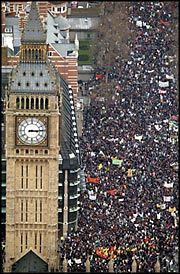


Although Amanpour interviews one Muslim woman of small comedy-club fame, who made a clear case for her distance from her extremist brethren, British Muslim women's voices were surprisngly lost in the documentary. Almost as if Amapour was operating within the discursive paradigm and boundaries as laid out by the extremist mullahs she derides.

While admittedly, a confident modern British Muslim woman who could have furthered the case for more likable British Islams, are unlikely to roam the streets of Bricklane, Southhall or Edgeware road, one just has to walk into the Queen Mary cafetaria or the charmingly decadent SOAS Bar to get a representative Muslim woman voice.

Despite all despites, Amanpour does a decent job. Kudos where kudos are due. She punctuates a wonderfully crafted narrative on the radicalization of British Muslim youth with extended dialog with the "Moderates." She interviews Hanif Qadir who runs a large youth center in London, the said female comedian, an musician who is interested crossing cultures, and a good imam who declares, "If you are evil, you can justify it with anything – Bible, Qur'an or Shakespeare."

Finally, the documentary is laudable for capturing certain priceless moments. There are great scenes of angry Muslim youth demonstrating outside a Catholic Church and locked in diatribe with irate Christian youth, in the wake of the Pope's now-infamous remarks.

Towards the end, there is another entertaining debate between a young "Moderate" Muslim man having a go at the more "Extremist"Uncles. All well and good, but in this scene and in a few others, I questioned the air of false credence to a notion that civilizational debates may at the end be timelessly generational.

A young "Moderate" Muslim man declares, to much applause from a British audience, "This [extemist Islam], ladies and gentlemen, is not an ideology, but a mental illness."


January 20, 2007

Present's Trespass on the Past

History or rather the space of history writing often becomes the battle-ground for competing visions of a nation. In the case of Indian history, many historians, many of whom work out of Delhi or American or British universities often find themselves in an inevitable dialog with present political concerns.


It is often the case that the most ancient of histories are ones with the greatest relevance to present political concerns. This can happen when nationalists start looking back to define a nation and explain roots of a people. For example, the questions of whether the Aryans (by extension, Hindus) were indigenous to India becomes important for Hindutva folks because much of their nationalist ideology rest on the assumption that Hinduism in native to South Asian soil while Islam is foreign. Some of this political rhetoric that drove people to destroy the Babri Masjid and dismember entire Indian Muslim populations, rests on the flimsiest archaeological and numismatic evidence. The other area of controversy in Indian history writing has to do with the period of Muslim rule in the subcontinent.


Debates rage over how benevolent and tolerant Muslim rulers were to the subcontinental population. On the one hand you have modern-day secularists propelled by the Nehruvian dream who highlight the tolerance of Emperor Akbar, his love for his Rajput wife, his concoction of a new religion despite protests from Muslim orthodoxy, the fusion of the "Indic" and the "Islamicate" in Indian cuisine, music and architecture and so on. On the other hand, you have badla-minded folks, with an axe to grind to undo what they see as historical wrongs, ranging from destruction of Hindu temples to Aurangzeb's persecution of certain prominent Hindus and Sikhs. Methinks Hollywood should make a movie on the Mughal Empire in all its splendor, diversity and tensions.


History-writing has also attracted controversy in Pakistan. After General Zia came to power, at a time when Islamism of a certain conservative kind was flourishing all over from Egypt to Iran to Afghanistan, new syllabi were devised to provide historical depth to Pakistan's Islamic nationalism. In Pakistani school textbooks, the 1965 war against India became absorbed into chapters on Islamic history and written alongside great battles in early Islam. Pakistani school children were goaded to understand their heritage as not one that was Indic, but one that was continuous with 10-11th century CE Turks in South Asia. Ridiculous but unsurprising then is President Pervez Musharraf's claim in his recently published, highly self-congratulatory autobiography, that both the Urdu language as well as Pakistani cuisine have evolved out of Turkish counterparts. Completely ignoring their more substantial similarties with languages and cuisines South Asian.

Historigraphy in Bangladesh has also drawn attention of late among secular circles, and rightly so. A certain politicization seems to be creeping in. After a conversation with Dr. Muntassir Mamoon, a popular Bangladeshi intellectual, greatly harangued by student wings of the ruling coalition - I confirmed that references to the word "Rajakar" are being dropped from secondary school history books ["Rajakar" ("Razakar" in Persian) was a term used for loyalists who were against the creation of the Bangladeshi state]. Moreoever, the chapter that describes atrocities committed during '71 on the Dhaka University campus, have dropped mention of Jagannath Hall. Curiously, Jagannath Hall was the site of the largest massacre of DU students, a largely Hindu dormitory. Furthermore, the new set of authors have dropped Sheikh Mujib's adornment of "Bongobondhu." And if one compares the older school history texts before and after the ruling Jama'at-BNP cartel - mention of Mujib has dropped noticeably.